

Overview
Adabas SQL Gateway provides real-time access to Adabas data by creating a virtual data services layer that abstracts data from various Adabas sources into a commonly understood, easily accessible SQL layer. You gain the power to grant users immediate access to Adabas data, no matter what platform that data resides.
In your quest to provide Adabas data to the people, tools, applications, and processes that need it in real-time, look no further than Adabas SQL Gateway.
Business users can conduct real-time business analysis of your Adabas data from their desktops by using standard SQL applications, such as Business Objects, IBM® Cognos®, Crystal Reports, Access®, Excel®, and Powerbuilder®.
Data warehouse managers can create federated joins between Adabas and different data sources, such as DB2®, Oracle®, and VSAM®. The Adabas SQL Gateway not only keeps information up to date but also supports transaction updates that write back to the data source.
Partners, customers, and employees can integrate their data with Adabas data, whether structured or unstructured, and deliver it to cloud and mobile applications.
Key benefits
- Open Adabas to new channels, applications, and business services with greater ease.
- Give business users direct access to real-time data through SQL-based business intelligence, KPI, and dashboard tools.
- Empower business users and IT staff unfamiliar with Adabas to access Adabas data when they need it directly
- Increase productivity
- Lower operational costs
How it works
To create a virtual data layer understood by a multitude of applications, Adabas SQL Gateway delivers a single metadata model that abstracts the source data into a common framework. The metadata model is efficiently managed within the SQL Gateway data dictionary, simplifying metadata import from data sources. Virtual tables are created to represent MUs (multi-value) and PEs (periodic groups), applying a relational model to the Adabas data.
Features
SQL support
Supports ANSI SQL, giving you the ability to write powerful and complex SQL statements and perform seamless, heterogeneous joins between Adabas and many other data sources. Simple queries and highly complex reports can be created using standard SQL-based data in a data warehouse.
SQL data dictionary
The SQL data dictionary is a central metadata dictionary that stores all metadata for data sources and targets. It allows you to import and reuse existing data definitions and metadata from Natural and Predict to open access to the desktop, the cloud, and mobile applications.
Advanced SQL optimizer
Displays the query plan and allows adjustments to control query execution paths, ensuring queries are optimized for maximum performance.
Federated joins
A data view across multiple data sources is maintained with heterogeneous joins.
Distributed processing
Reduce the workload placed on the mainframe by distributing query processing among multiple systems. CPU-intensive operations are performed where the gateway client resides (i.e., Linux® or Windows®), while the database engine on the mainframe performs the tasks for which it is best suited.
Full transactional support
Perform inserts, updates, and deletes in a complete unit of work to roll back or commit to maintain the integrity and currency of data.
Large Object (LOB) support
Store and retrieve large objects, such as pictures and videos, using SQL to support media-rich applications.
64-bit support
Supports applications on 32-bit and 64-bit platforms.

Stay connected
Join the community and follow the latest news about Adabas & Natural in the Software AG Tech Community.
Adabas & Natural
Software AG partners with businesses to modernize Adabas & Natural applications, ensuring efficiency and future readiness through digital transformation strategies.
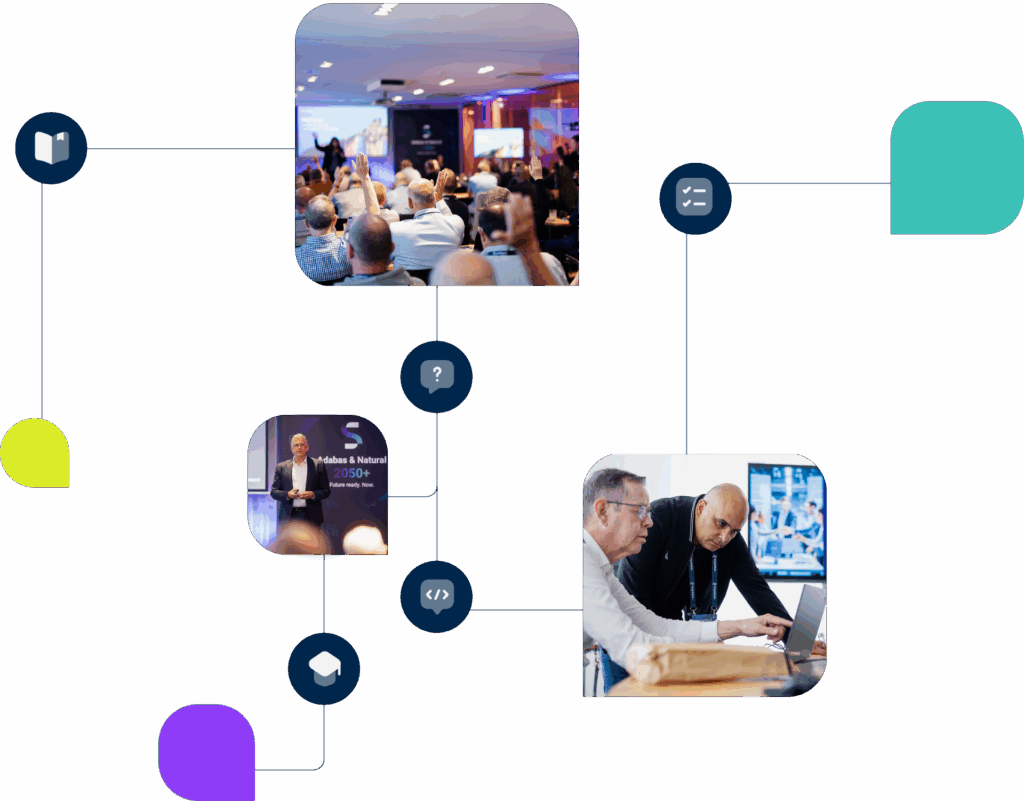
User Groups
Joining user groups provides networking, learning, and the chance to influence product development while accessing valuable insights and events.