


Skills
Major enterprises are achieving up to 97% batch COBOL CPU savings without changing a single line of source code. Learn how leading organizations are managing peaks, reclaiming capacity, and solving contention through seamless workload redistribution.
We talk to customers every day about the challenges inherent in managing high-volume mainframe environments where efficiency and cost containment are top priorities, and we know capacity concerns aren’t always just about high workload volume. They’re about too much workload concentrated in the same window on the same resource.
Contention happens when:
JOPAZ rebalances the scales by redistributing heavy COBOL batch workloads to more efficient engines, changing the behavior of those peaks without touching the applications.
What changes: Execution path, CPU behavior, and runtime environment (JVM)
What doesn’t: COBOL source code, data, scheduling framework, and outputs
Below, we look at how three major companies across different sectors achieved incredible CPU savings while solving their contention challenges for good.
Join 15,000+ other mainframe users receiving expert advice and industry news in their inboxes.
Thanks. You’re on the list.
Please review the highlighted fields and try again.
For a major North American member-service organization providing automotive, travel, and financial services, creating predictability was a top priority. Their batch processing was driving up Rolling 4-Hour Average (R4HA) costs, creating an urgent need for better workload distribution.
The organization turned to JOPAZ to address the root cause of workload contention.
This allowed them to leverage IBM zIIP engines, reducing peak GP pressure by redistributing execution
The impact was immediate and substantial:
Without JOPAZ
With JOPAZ
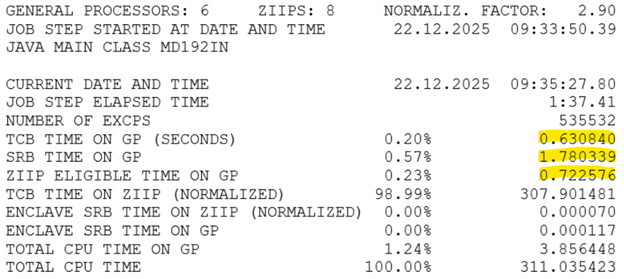
A major North American energy provider with a large Db2 footprint needed a more strategic way to use their existing processing resources.
Similar to the first case, the customer turned to JOPAZ to make their workloads eligible for execution on their zIIP engine. In this instance, the zIIP engine had limited available capacity for use by JOPAZ, so following the success of the initial results, a second zIIP was added.
Without JOPAZ
With JOPAZ – single zIIP engine
With JOPAZ – 2 zIIP engines
Initial testing was so promising that the customer immediately contracted dedicated resources to see the project through to completion. Most importantly, this was achieved with no change to code or business logic.
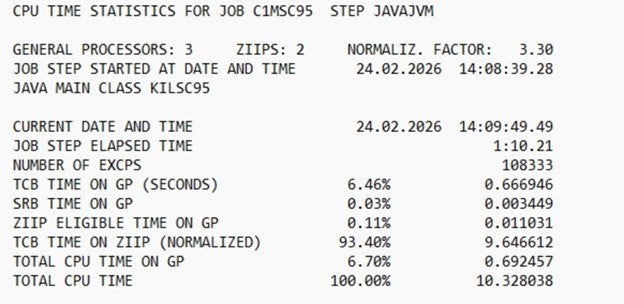
In South America, a leading payment technology company processes billions of transactions annually. Unlike the other examples, this was a pure VSAM environment with no traditional databases, and it featured exceptionally large and complex applications.
With four underutilized zIIP processors already sitting in their rack, the company saw JOPAZ as the perfect way to reclaim GP capacity. They started by recompiling a complex 54,000-line program. In the words of our customer, “If JOPAZ can handle this application, it can handle anything.”
As our customers can attest, modernization doesn’t have to mean a risky, years-long migration to the cloud. The challenge is not whether COBOL works. It is whether a small number of jobs are driving disproportionate pressure during critical windows. Rather than changing their workloads—rewriting, rescheduling, or removing them–companies are reclaiming nearly all of their batch COBOL CPU usage by changing where they execute.
Whether you’re working with Db2, VSAM, Adabas, or sequential files, the results consistently show above 80% CPU savings, and often as much as 97%, all while keeping your proven business logic exactly as it is.

Discover how JOPAZ demo Modernization transforms your COBOL workloads to free up valuable resources without business risk.

JOPAZ compiles COBOL code into Java bytecode to run workloads on the zIIP processor, reducing mainframe CPU use and freeing capacity without code changes.

JOPAZ optimizes COBOL workloads on IBM Z by compiling them to zIIP-eligible Java, reclaiming GP capacity for AI, analytics, and innovation with zero disruption.