


White Paper
Navigating IT Chaos: Strategies for Business Resilience
“Everything is ITs fault.”
That’s not true, but it may be the sense that many IT teams are getting from their business counterparts. Everyone in the company wants to innovate faster, but isn’t willing to wait for IT to properly implement new tech. Especially with the recent wave of Generative AI (Gen AI) platforms, this means shadow IT is popping up in every corner. But this cavalier approach exposes companies to regulatory and security risks. Which, ironically, also becomes IT’s problem (or is even blamed on IT).
This chaos, of course, didn’t start with the Gen AI gold rush. The year 2020 forced businesses into digital transformation programs practically overnight to keep running. However, in most cases, this rapid transformation wasn’t done perfectly and instead created new challenges.
One example: 44% of businesses are having trouble managing new and old systems effectively side by side. Businesses still rely on enterprise applications that have been in place for years (even decades) to run core business operations. But new systems are introduced in increasingly distributed ways. The challenge is to connect them all together and manage them effectively.
There is an opportunity here to make order of this IT chaos—by truly understanding the whole infrastructure, connections, dependencies, and duplications. Then IT departments can operate efficiently, securely, and actively drive innovation for the business.
When chaos is out of the equation, IT will be blamed for less and praised for more.
IT chaos: The context
Organizations have continued to expand their technology infrastructures—investing in new tools to ensure their competitiveness, efficiency, and governance. This essential investment must continue, but critical core systems also need to be effectively managed. These core systems rarely have the same standards and pre-designation for connectivity as newer technologies being invested in.
The outcome is an IT portfolio so heterogeneous that it does more harm than good. Businesses end up paying for duplicate platforms. Information is stored in silos, so decisions are made with incomplete information. Time and energy are spent untangling IT chaos instead of delivering innovative, IT-driven solutions.
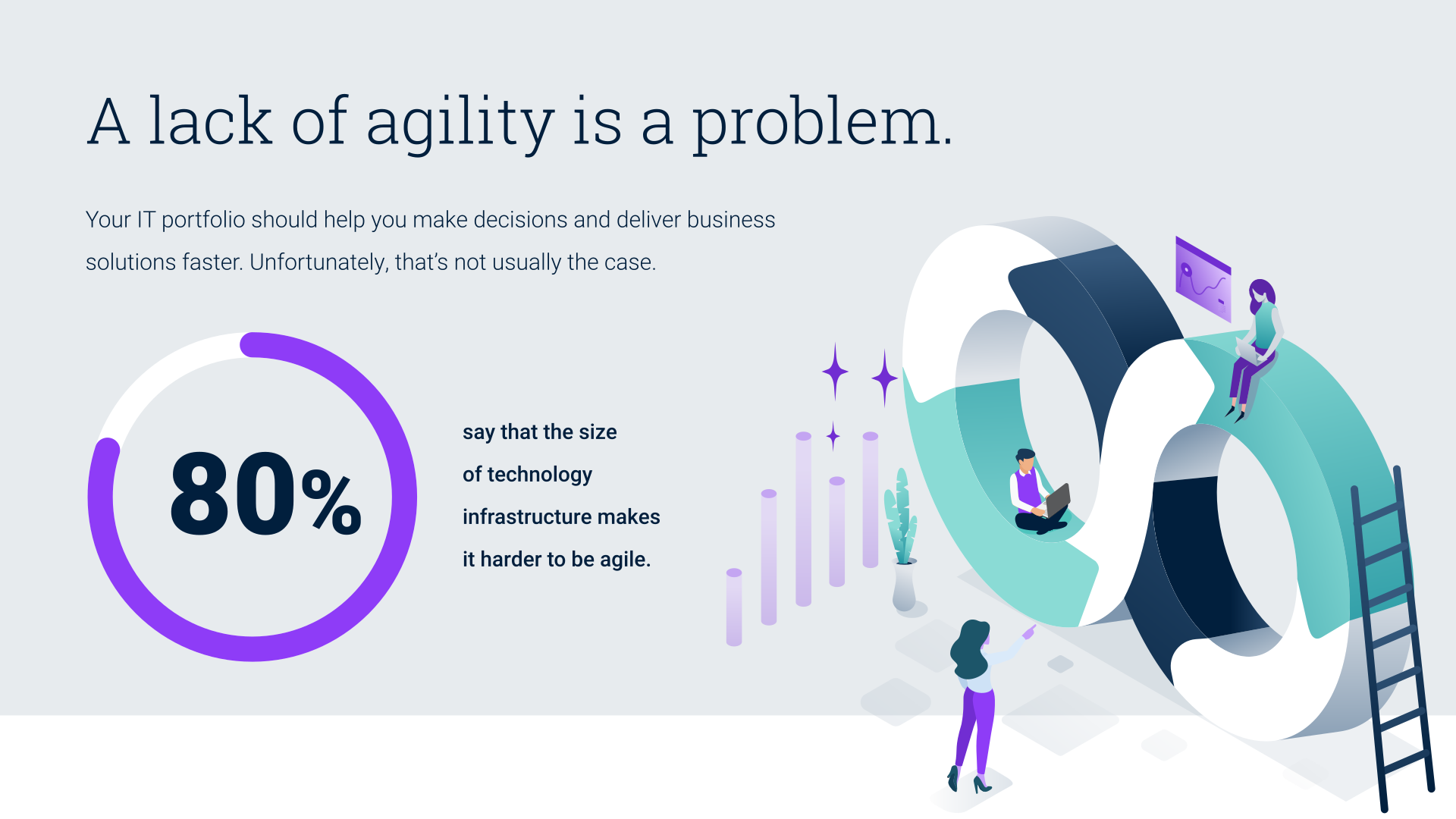
In fact, 80% of businesses say the size of their technology infrastructure makes it harder to be agile and slows their decision-making.
This has short- and long-term implications for digital transformation. Making the wrong decision in the short term can send the whole company down an unnecessary path that takes a lot of effort to work back from.
Losing control
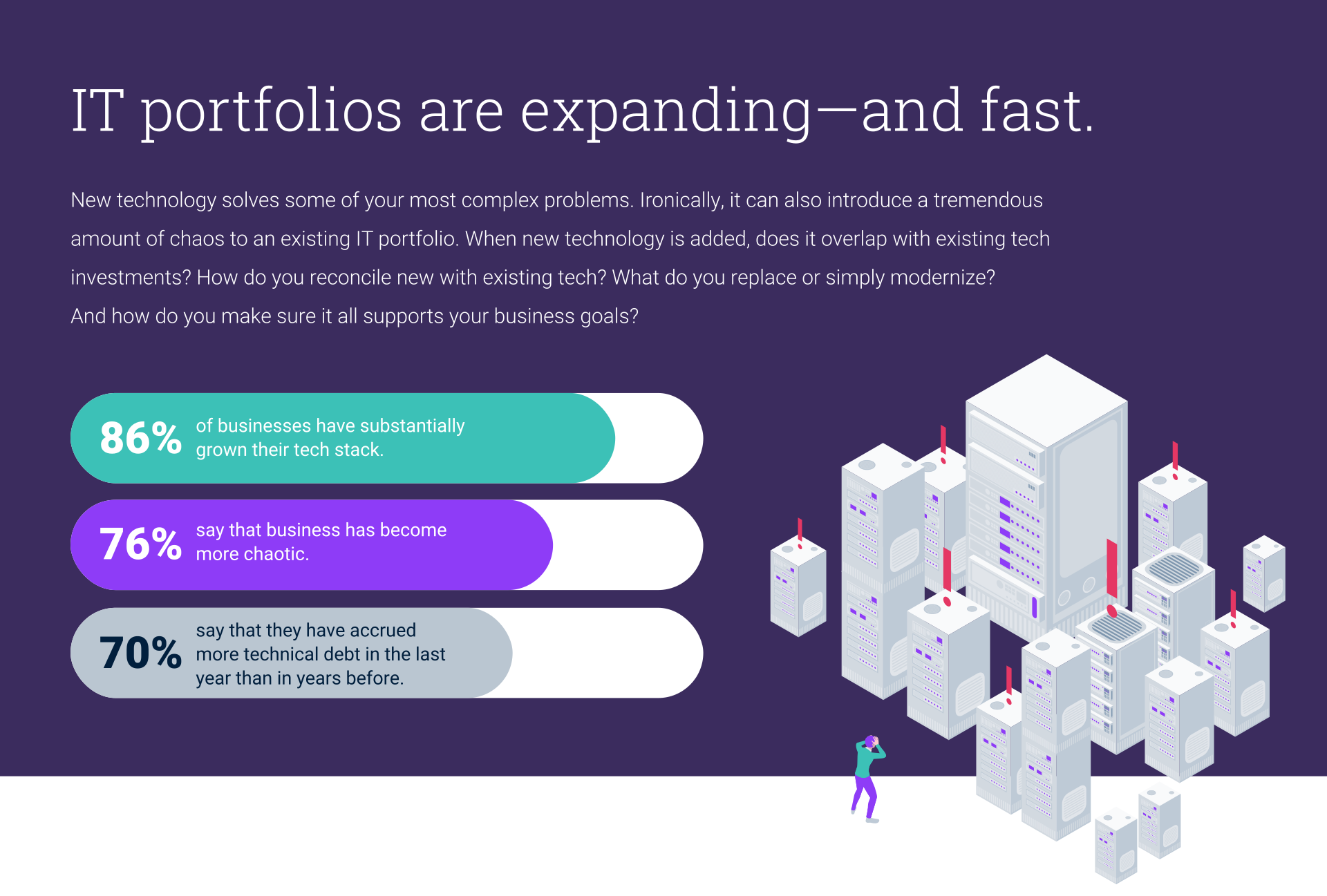
The vast majority (86%) of businesses have expanded their tech infrastructure in recent years, which is not surprising given the push for remote work and the digitization of products and services. However, the ability to manage the entire infrastructure has not kept pace with the change. The result is a loss of control, and the nature of the technology expansion is a cause for further concern.
More than two-thirds (69%) of organizations have more disparate applications/systems than two years ago. And 71% say that number will be higher in two years. Just under half (42%) have done all of this without a clear plan for bringing these systems together. As a result of these—and other—factors, 70% say that they have accrued more technical debt in the last year than in years before, underscoring the need for strategic debt management.
In addition to the complexity of managing “legacy” and modern systems together, it’s also increasingly slowing down business innovation. By reducing complexity, IT transparency provides greater insight into the systems that support key initiatives or practices, enabling organizations to make more informed decisions. These decisions could relate to initiatives such as expanding on-premises services, moving to the cloud, or adopting a hybrid cloud model that unifies cloud and on-premises infrastructure into a flexible, cost-optimal IT environment. Alternatively, more information on which systems are underused and which are business-critical can create opportunities to remove dormant technology and create new investment plans using the resulting cost savings.
From managing to enabling
This picture of a sprawling landscape and the challenges of managing new systems alongside established ones is the picture of IT chaos. When organizations need to understand which systems are being used, by whom, and for which tasks, getting an accurate picture is as essential as it is challenging.
The fact that managing systems is challenging now is a bad omen for the future, when organizations want to grow and remain competitive. We know the situation is going to get more complex. More and more resources will be required to make sense of the new landscape and manage technical debt. This can pull both time and resources away from innovation projects and growth initiatives. Getting your arms around all technology investments, understanding what you have, its value to the business, and opportunities for change is the only way to plot a course forward.
As expansion continues, all IT systems need to be continually assessed for the value and business criticality they bring to the enterprise, relative to their cost. They must be effectively governed—both for compliance and proof of value. And they need to be harmonized to ensure the best conditions for success with future transformation efforts. These considerations apply to all IT investments, and without this understanding, risks to efficiency, governance, and competitiveness are amplified.
IT chaos: The risks
The complexity of the IT landscape can make even seemingly simple tasks slow and difficult. When the whole organization is slow to move and react, at risk from any number of directions, and always trying to ‘keep up’, business will be disrupted.
As an example, one automotive manufacturer’s IT landscape had become impossibly complex as it digitalized its systems. It was struggling to identify and manage all the “connections and interdependencies among software, people, processes, and manufacturing equipment.” If anything went wrong in any of those myriad systems—without a central repository in place—the team wouldn’t know where it happened and how it might impact production. (Integrated Portfolio Management: Better Visibility, Easier Decisions, Lower Costs; Aite Group, 2020)
The pace of change isn’t going to slow any time soon either, so the longer organizations remain unable to see through their IT Chaos, the longer they are exposed to fundamental risks.
Poor governance
Governance is, at its core, about establishing an understanding of what’s really happening within an organization so you can set up policies, guidelines, and procedures for critical areas of the business. For example, what financial and reputational impact would result from unplanned downtime of core applications? Many lack this understanding because they don’t have a single source of truth that provides visibility across the whole technology landscape.
As the technology portfolio grows and becomes more complex, keeping a record of it in dispersed corners of the organization exacerbates governance issues. Two-thirds (65%) feel that tech complexity worsens governance issues. Good governance is important for regulatory compliance, of course. New, stringent, wide-reaching laws—such as the EU’s Digital Operational Resilience Act (DORA)—are coming into effect, mandating how much organizations need to understand—and demonstrate their understanding of—the structure, operations, and risks within their businesses.
But good governance is also key for cybersecurity defenses—an important part of operational resilience. How can you know how to protect the business if you don’t know what you’re protecting? And from a business planning perspective, good IT governance can help to scrutinize the value of new investments in terms of the return they are likely to bring to the organization.
Take, for example, a recent ransomware attack on UnitedHealth Group’s Change Healthcare, where a hacker “severed a key link between medical providers and their patients’ insurance companies in the worst health-care hack ever reported.” Change Healthcare had to provide $2 billion in advances to pharmacies, hospitals, and other providers to ensure business continuity. These attacks are not uncommon—and increasingly difficult to avoid without proper IT governance.
Governance and visibility go hand in hand and are two of the mainstays of compliance. Another is data accessibility. Half of companies (47%) say that data is often inaccessible when it’s needed. If it’s needed for a regulatory compliance request, it could be very costly to extract, especially if it is locked in a highly secure transaction system. It’s one thing to know that certain information exists in system ‘X’, but if it cannot be accessed quickly and easily, and in a meaningful format, then there could be a compliance issue.
Spiraling costs
As the tech portfolio expands, it creates pressure on resources. In some cases, it’s pure system costs. In others, it’s a knock-on effect of applications producing more data and requiring more capacity and processing power. In any event, the result is that costs can get out of control.
Take enterprise applications, for example. As a business grows and becomes more successful, these applications are called upon to handle increasingly large volumes of transactions while maintaining fast processing speeds and SLAs. Businesses can face a dilemma: either increase costs to scale their processing capabilities or underdeliver on processing times. It becomes imperative to find solutions that avoid disruption risks for service delivery and business continuity.
Many migration projects that aim to change costs can disrupt business-critical applications that have been relied on for years. While trying to get a grip on costs, it’s important not to sacrifice established reliability and performance for the long, costly road of replacing applications built over the years that reflect the processes unique to your business. Rarely do these projects succeed, and they cause significant disruption to the business.
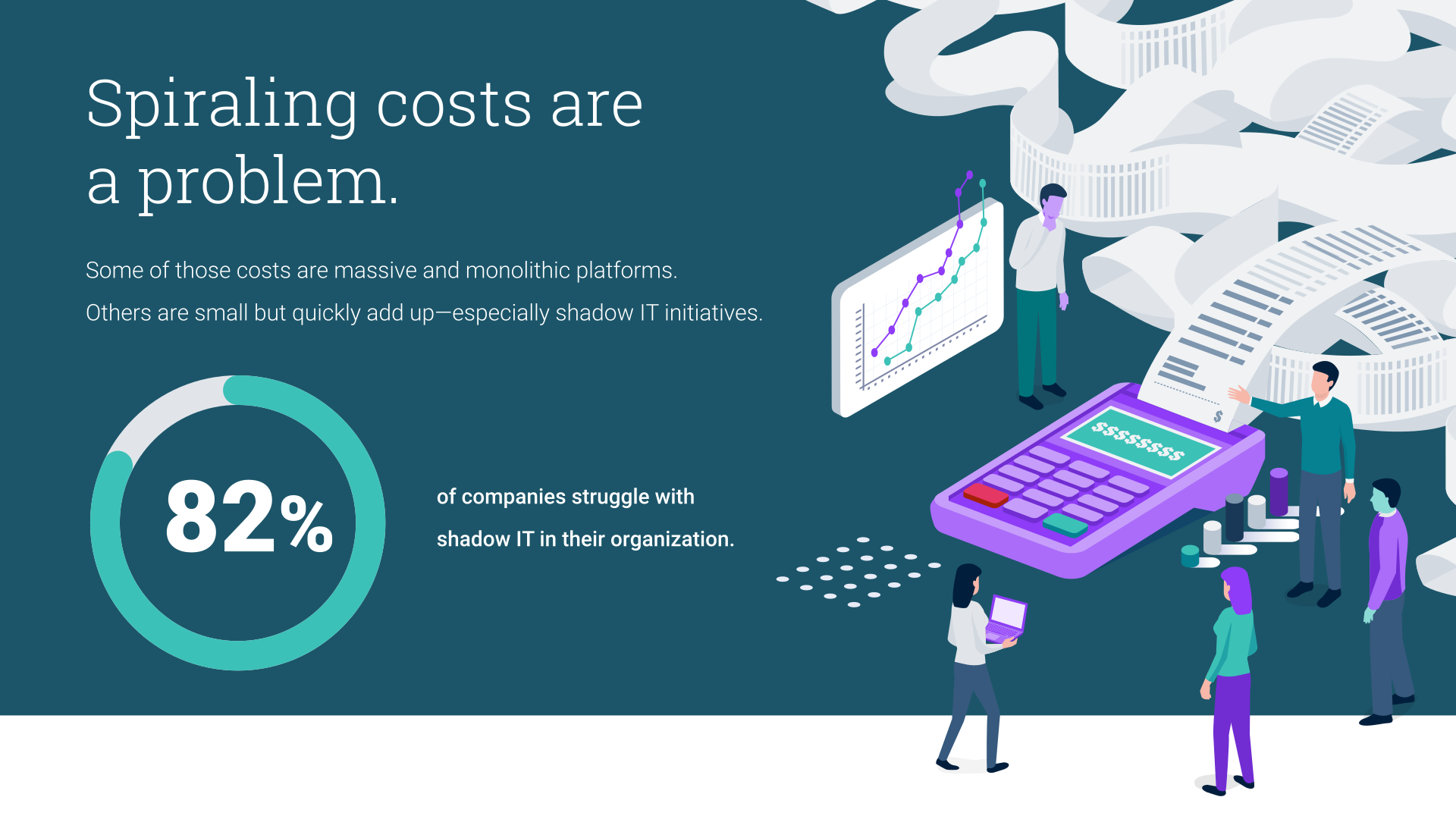
There are also many simpler ways that costs can build up. Not only is the enterprise tech landscape growing and getting more disparate, but business users are becoming more adept at buying and implementing their own solutions. They download applications, create processes, and spin up as-a-service instances, perpetuating the sprawl. This “shadow IT” just adds to the IT chaos. AI will only accelerate this proliferation. Beyond questions of control and governance, this also increases the likelihood of duplicated technologies. The notion of multiple systems performing the same tasks has been problematic for many years, and the challenge is growing.
So businesses are sinking lots of budget unnecessarily into technology, many of them with no clue that it’s even going on, because the shroud of IT chaos protects these duplications and inefficiencies.
Disrupted service quality
In an era where differentiation is more important than ever, maintaining service quality is paramount. This becomes harder to do when IT chaos disrupts key processes. One in five (22%) say tech-related disruption is frequent, with 89% saying it happens to them. Every time it does, there is a risk of customer churn and lost revenue.
These things happen because systems become overloaded, they fail, and the problem can’t be identified quickly because their interdependencies are not fully understood. This could be a transparency issue, or processes may rely on legacy systems that cannot respond quickly enough when needed.
Future service development can also be affected. Around 80% of organizations feel that complex tech slows them down in launching new products/services, improving experiences for customers and employees, and increasing revenue/profitability. Often, new product development and innovation are stifled by IT chaos. Disconnected systems and a lack of transparency can cause unexpected delays in key developments.
IT chaos: Overcoming the complexity
Understanding is the first step on the journey to transformation, compliance, and efficiency. Understand what you have, what it does, and the value it brings to build a growth platform. Most organizations (81%) say that a major pain point is not having a clear view/management of all their systems. So how can they fix this?
Multiple technologies can come together to alleviate the IT chaos most businesses are experiencing. Enterprise Architecture Management tools create a single source of truth for organizations to act upon. Strategic Portfolio Management can reduce cost and complexity and clear the path forward for innovation. DevOps environments can help accelerate innovation for existing enterprise applications. Adopting microservices, containers, and cloud-native architectures can migrate on-premises applications to the cloud. APIs and data integration platforms can help connect legacy applications to more modern systems, enabling a successful hybrid cloud architecture that accommodates a mixed computing environment.
When organizations have a better understanding of their entire architecture and can gather insights from it, they are in a much stronger position to act and succeed. Informed freedom of choice over what to host in the cloud and what to keep on site ensures costs, risks, and scalability can be optimized. Processing data in core systems at scale and at cost-optimized levels ensures that organizations can cope effectively with increased data flow. They can make strategic decisions about which systems support business goals and which do not.
Achieving business goals
All business initiatives rely on IT to become a reality. Whether that’s launching new digital products and services, building new efficient business models, or sustainability—you name it, and IT has to be a key component of it. Indeed, 93% of businesses have adopted or plan to adopt a digital-first business strategy.
IT chaos can muddy the waters and prevent business and IT from syncing up as they should. By capturing the right information, organizations can build a single source of truth that enables informed decision-making. Organizations use Enterprise Architecture tools to create a common language and understanding for everyone in the business, thereby forming a single source of truth for decision-making.
It also means that everyone in the business can see whether IT is, in fact, on the right track for achieving overall goals. Relevance to business objectives and costs are key components not only for aligning with but also for driving business goals. It’s important to know where you stand.
Similarly, delving into core systems to understand their value is an important ongoing process. Some legacy systems—and 80% of organizations feel the majority of their technology is “legacy”—are candidates for modernization and cloud transformation. Old legacy UNIX programs and databases that are slow and costly can be easily migrated, breathing new life into processes and the dependent data. That not only achieves cost optimization by reducing the types of hardware supported, but also frees up resources to focus on developing new processes to support and differentiate a growing business.
The Catholic University of the Sacred Heart moved its core university system to the Azure cloud, and in so doing, cut average execution time for transaction processing by 50%. It did this with system availability of 99.56%, and a service level—including scheduled downtime and the migration to Azure—of 99.73%. It also made 90% of services available for direct student use—up from 70% previously.
Productive and efficient
Every business would like to be more productive and efficient. To deliver better products and services at a lower cost. This is truly differentiating.
At a core systems level, consider optimizing mainframe costs and scalability by moving workloads into less expensive processors. This can help you improve the scalability of these systems while reducing costs. The best of both worlds. Dataport has 17,000 TB of data and was able to reduce the load on main processors by 99% and CPU consumption by 75%. It’s also set itself up to implement an AI strategy by innovating within its mainframe environment.
Exposing some elements of core systems to the customers and citizens opens up tremendous efficiency opportunities. The Israeli Ministry of Labor exposed its mainframe to the web, reducing process execution time from months to hours. There has also been a 570% increase in one year in the number of assignments approved.
Maintain and modernize applications in DevOps environments, which are easy to learn and therefore help bring new talent on board. This helps support innovation while taking advantage of new tools that can optimize the costs and resources dedicated to these efforts. The Tel Aviv Stock Exchange gave its developers greater speed and agility by bringing them together under a single DevOps architecture, while preserving 20-30 years of core knowledge in its backend system.
Agile and resilient
Speed and agility must be key characteristics of businesses hoping to ride the many waves of change prevalent in the world right now. This begins at a foundational level within IT systems. We already said that IT underpins all major business initiatives—it also must be flexible, transparent, and as simple as possible to cope with disruption.
Modernized IT landscapes are, by nature, more open and connected, allowing a hybrid architecture to flourish. Not all systems will or should be in the cloud, but having the ability to see into everything is important. The important thing is to make those decisions with a full understanding of the impact on other systems. IT chaos can be a big roadblock when you need to move quickly, but if you use strategic portfolio management as your GPS to help with the journey, you’ll find your way.
The same approach that allows for more agile systems also helps make them more secure and compliant. The resilience that can be built by having transparency as a core requirement is significant. Spotting potential vulnerabilities helps build stronger cybersecurity defenses. Spotting power-hungry systems helps to fulfill sustainability objectives. Enabling controlled data movement allows for stronger operations in conjunction with regulations.
Ensuring data is accessible when needed is a key part of governance and agility. Whether for compliance or to allow people to do their jobs effectively, they need the right information at the right time to make good decisions. Nowhere is this more important than in law enforcement. And the Delaware Criminal Justice Information System innovates around its mainframe to enable real-time decision making and e-ticketing.
In addressing IT chaos and control, we must acknowledge that 82% of companies struggle with shadow IT. Fighting this is a losing battle. The answer is to embrace IT-savvy business users and involve them in planning and managing the IT portfolio. The proliferation of systems cannot possibly be maintained by IT alone. And as the products and services that business users manage become increasingly digital—and more complex—the burden on IT to maintain them at the speed the business requires will become unbearable. Automation, low- or no-code, and AI can all help business users manage more complex systems—and do so with a business lens. Collaborative strategic planning and portfolio management tools engage business users as critical stakeholders in ensuring IT can support business needs.
Final word
The complexity of enterprise technology has always grown. Today’s rapid proliferation of new tools and an upskilling of business users (naturally or through AI) means that IT teams cannot centrally manage everything. They need new tools to reduce costs in core functions and scale them up to meet today’s demands. They need new tools to manage the sprawling portfolio. Technology expansion doesn’t automatically lead to IT chaos… although many are feeling that way right now. With the right tools, organizations can calm the chaos and focus on efficient, well-governed, and innovative business growth.

Why Enterprise AI Fails: The Canonical Truth Problem
Discover how your enterprise can go beyond an AI pilot with the right data. Learn how to bridge the gap between outdated data and real-time systems of record to drive reliable, high-impact outcomes.

Mainframe data integration for digital innovation and cloud analytics
Leverage your mainframe data to make better decisions and serve customers. The right approach to a hybrid architecture allows seamless operations between on-premises applications and cloud platforms.

Save mainframe costs: zIIP™ your Adabas & Natural apps
Can you afford not to zIIP? Take a deep dive into how Adabas & Natural can immediately reduce your mainframe TCO.