


Optimización de Mainframe
Most batch problems are peak problems: The hidden cost of mainframe bottlenecks
Many mainframe batch issues are peak problems, not capacity limits. Learn how shifting COBOL workloads to zIIP reduces GP spikes and improves performance.
It’s a familiar problem: during your most critical processing windows, your General Purpose (GP) processors redline and latency climbs, putting mission-critical SLAs at risk.
The natural instinct is to add more capacity. If the engine is full, we need a bigger engine, right?
In good news for your mainframe TCO, the answer is not necessarily. In fact, many batch problems aren’t capacity problems at all—they’re peak problems.
The peak myth: It’s not a capacity problem
A CPU at peak capacity is a city deadlocked during rush hour. Too many vehicles trying to squeeze through the same narrow bottleneck turns the highway into a parking lot. But with proper planning—and a few express lanes—traffic can flow once again.
Batch peaks aren’t necessarily a sign that your mainframe is full. Instead, they could be hinting that your GP engines are being utilized inefficiently. Simply adding more GP capacity might relieve bottlenecks in the short term, but it’s akin to widening the highway when there are easier solutions.
Understanding the deadlock
When GP utilization spikes, the mainframe attempts to solve its own problems. As the CPU nears 100%, it spends an increasing amount of time managing the queue rather than executing the work. This leads to:
- Increased latency as processes wait longer for cycles.
- Missed SLAs when batch windows extend into the next business day.
- A deadlock where nothing moves because the CPU is too busy trying to optimize its way out of the resource contention.
And GP cycles are the most expensive resources on your floor. Using these cycles to run routine COBOL batch is a poor allocation of resources, especially when a vastly more cost-effective and efficient engine is sitting in your stack, waiting to be put to use.
Únete a más de 15.000 usuarios de mainframe que reciben consejos de expertos y noticias del sector directamente en su correo electrónico.
Gracias. Estás en la lista.
Revisa los campos resaltados e inténtalo de nuevo.
The express lane strategy: Enter the zIIP
If the GP engines are the standard city streets, the IBM zIIP (System z Integrated Information Processor) is the express lane. Traditionally, zIIPs were reserved for very specific workloads like Db2 or XML.
Sin embargo, ahora es posible que el 80 % o más de los procesos por lotes estándar en COBOL puedan ejecutarse fuera del procesador general.
By redistributing the heavy lifting of COBOL batch from GP to zIIP, you flatten the GP peaks, and stay safely beneath your peak usage limits by reclaiming your existing capacity.
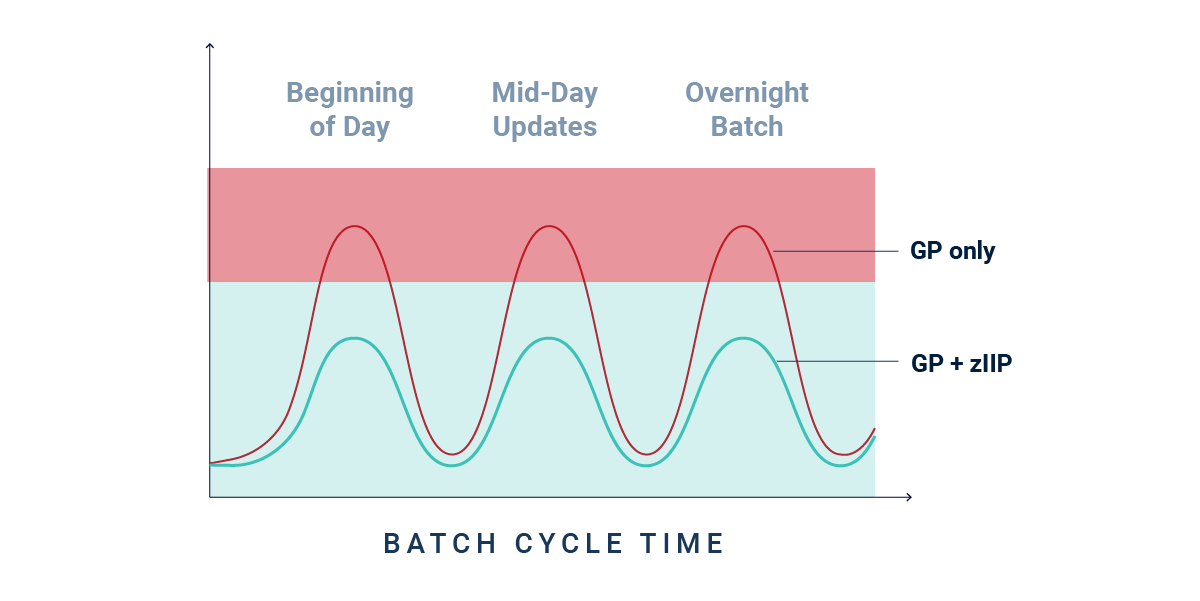
Why this is the most scalable solution
There are three reasons why zIIP redirection is the sustainable path forward for capacity-conscious mainframe shops:
- This transition happens without code changes. Your developers don’t have to rewrite or refactor decades of COBOL logic. The redirection happens at the functional level.
- By lowering your GP utilization, you stay under your Rolling 4-Hour Average (R4HA) limits, even when latent workloads enter the mix. For users on a Tailor-Fit Pricing model, avoiding capacity spikes will keep you in a lower tier for the next contract cycle.
- When you remove the workload contention, your batch window becomes predictable. The risk of an SLA breach vanishes.
Resultados
By leveraging zIIP, you aren’t just moving work, you’re moving it faster. Data becomes available to the business sooner, reducing downstream latency. Most importantly, freeing up GP cycles gives the business the space it needs for new initiatives, without requiring new capital.
Reclaim resources: Free your mainframe from endless optimization efforts, while saving over 80% batch COBOL CPU for new projects.
Solve workload contention: Get high performance even at peak processing times.
Create budget predictability: Plan for upgrades on your schedule instead of reacting to capacity pressure.
Risk-free modernization: Preserve existing applications, data stores, scheduling frameworks, and outputs while modernizing in place.
Think traffic, not engines
The goal of modern mainframe management isn’t to have the biggest engine—it’s to have the smartest traffic flow. If you are struggling with batch windows and GP spikes, don’t look for more capacity. Look at how your workloads are optimized.
Our recommendation: audit your peak GP utilization. See how much contention is actually routine COBOL batch, and get in touch to see how JOPAZ can help you reclaim GP capacity by making workloads eligible for zIIP.

Demostración de JOPAZ
Descubre cómo la optimización con JOPAZ transforma tus workloads COBOL para liberar recursos valiosos de procesamiento de tu mainframe sin riesgo para el negocio.

Reduce workloads COBOL en el mainframe con JOPAZ
JOPAZ compila código COBOL en código byte de Java para ejecutar cargas de trabajo en el procesador zIIP, lo que reduce el uso de la CPU del mainframe y libera capacidad sin necesidad de modificar el código.

Optimización de Mainframe: Maximiza el potencial de tu IBM Z sin riesgos
JOPAZ optimiza workloads COBOL en IBM Z compilándolos en Java compatible con zIIP, lo que permite liberar capacidad de GP para la inteligencia artificial (IA), el análisis de datos y la innovación sin interrumpir tus operaciones.